 AI and Lean Six Sigma
Coaching by Exception: The Andon Cord for Your Coaching Practice
July 25, 2026 · 6 min read


Mike Higgins · July 1, 2026 · 7 min read
Up to one in three Lean Six Sigma projects fail to deliver results — more than half in the hardest environments (Antony et al., 2020). Ask why, and you get the same list that's topped the research since the late 1990s: weak management commitment, resistance to change, poor rewards, inconsistent control (Antony et al., 2020). None of it will surprise anyone who's run or participated in a deployment.
But here's what should bother us: despite explosive growth in training and certification over the last 20 years, the project failure rate has barely moved. If failure were mainly a knowledge problem, making the knowledge that much easier to get should have changed that. It didn't — which means the real cause is something more training can't fix, and it isn't random project misfortune either. Project outcomes are downstream of how a program is run: the strategic choices a deployment makes, including how much coaching to fund and how to supply it, quietly set the conditions each project runs under.
Lean Six Sigma is a practical skill — and practical skills are coached, not memorized. Nobody becomes a competent surgeon or violinist by passing an exam; they build judgment by applying the skill under someone experienced who guides, teaches, and challenges them — a process researchers call deliberate practice, which generally can't be self-administered (Ericsson et al., 1993). The research bears this out for Lean Six Sigma specifically: the tacit, person-to-person knowledge a coach transfers predicts project success as much as all the statistical technique combined (Anand et al., 2010), and the experience of the person guiding the project is its single strongest predictor (Easton & Rosenzweig, 2012).
So the real question isn't whether organizations coach. Most try to. It's how much coaching time each practitioner actually gets — and that's where the math turns against us.
Organizations invest readily in training, because its cost is visible and its deliverable is countable. But training doesn't buy the coaching contact time required to build judgment and skill in a practitioner. A Master Black Belt coaching 40+ practitioners and active projects across a large regional area doesn't have the time to offer the quality and timeliness of coaching needed to build mastery. Hence, in some instances it becomes the occasional check-in. And "occasionally" is exactly when a project stalls in Measure or Analyze, loses momentum, and quietly dies — or closes on paper and fails to sustain because no one was there in Control to make the gains hold.
Every discipline that builds tacit skill has found the same thing. In education, one-to-one tutoring lifts the average student above roughly 98% of a conventional classroom — an effect so well known it's named after a standard deviation (Bloom, 1984). In sport, coaches converge on five to eight athletes per coach, tighter for beginners. In surgery and music, training never scaled past near one-to-one for the parts requiring in-the-moment correction (Ericsson, 2004). Skill mastery is intensity-dependent, and intensity falls as one coach is stretched across more learners. Lean Six Sigma obeys the same law — we just rarely name the ratio, so we rarely diagnose it when it's the thing killing our projects.
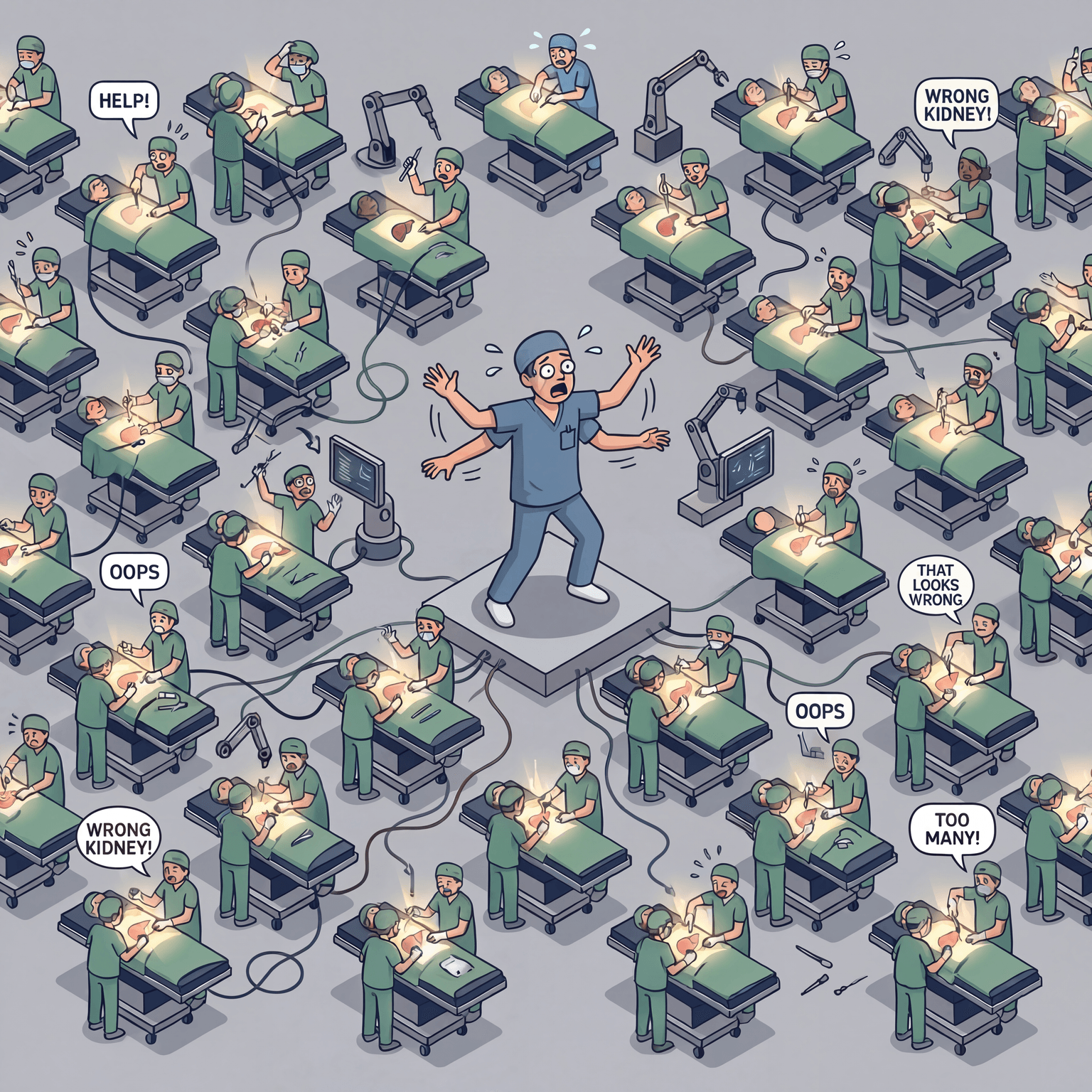
There are really only two ways to improve it, and both hit a wall.
Bring in outside consultants. Good consultants are genuinely valuable — deep experience, seen dozens of deployments, able to lift a program's coaching quality immediately. I'm not here to knock them; they're among the most capable practitioners in this field. But expert external coaching is expensive, so the ability to scale is limited. A little expert coaching spread across many practitioners produces exactly the wide ratio and long gaps we're trying to eliminate. The constraint isn't the consultant — it's that scarce expert time is priced accordingly, and ROI pressure forces you to ration it.
Build your own internal capacity. The right long-term answer — and it takes years. Developing a Black Belt who can genuinely coach, then a Master Black Belt above them, isn't a training-calendar problem but an experience problem: roughly five years in the role and about ten completed projects before someone is ready to mentor at the Master Black Belt level (American Society for Quality, n.d.). The budget can't compress that. So while you build, your trained population grows faster than your coaching bench, and the effective ratio silently widens.
There's a third path, the first two obscure — and I think it's the most powerful. The ideal coach for a practitioner is often their own direct manager, not a central Black Belt they see every few weeks. A manager who coaches doesn't carry fifty belts; they carry their team, and they see them daily. That proximity attacks both failure drivers at once — it collapses the ratio and shrinks the gap between touchpoints — and it turns the top-ranked failure factor, weak management commitment, from a poster into structure. When the leader is the coach, commitment is built in.
The most developed expression of this idea is Toyota Kata, which teaches improvement and coaching as daily routines through a structured coach/learner model (Rother, 2010). It's worth being clear that Kata is a fundamentally different deployment approach than traditional Lean Six Sigma — daily improvement routines rather than episodic chartered projects — and its near-daily cadence is essentially a structural fix for the very coaching gap this article is about. That's telling: an entire methodology grew up around closing the interval between coaching sessions. But adopting Kata means re-architecting how an organization runs improvement, and it still leans on external coaching until internal capacity matures. It's a well-designed path through the gap, not an escape from it — and it isn't how most organizations have run continuous improvement over the last 25 years. Most still rely on a central champion and waves of training: the traditional, project-based model.
Which brings the question back to where most practitioners actually live. Whether you run DMAIC, Kaizen, or Kata, the binding constraint is the same: how do you keep the interval between coaching touchpoints short enough that judgment and skills actually develops?
Blaming any single actor misses the point. The failure factors are real. Consultants are valuable. Internal capability-building is correct. The problem is that every honest path to better coaching collides with the same reality — expert guidance is scarce, and scarcity plus ROI pressure produces thin coaching and long gaps.
So the question worth asking isn't who's to blame. It's this: how do we hold the effective coaching ratio near the high-touch end — timely, methodology-aware, Socratic guidance at the moment a practitioner is stuck — without being rate-limited by the cost of consultants or the years it takes to grow a Master Black Belt?

That's not unique to us. Education and medicine have worked this problem for a generation, and their answer wasn't to abandon individualized coaching — it was to engineer systems that reproduce a coach's core functions and deliver them at a ratio no human expert could sustain. Intelligent tutoring systems already recover much of the one-to-one advantage (VanLehn, 2011); simulation substitutes for scarce mentor time in surgery. When you can't clone the expert, you build something that carries the expert's method to the practitioner on demand.
That's the gap worth solving in Lean Six Sigma — not to replace consultants or shortcut the development of real Black Belts, but to keep a practitioner from sitting stuck for two weeks when a well-timed, methodology-grounded nudge would have kept the project alive. The DMAIC framework works. The failure rate was never really a methodology problem — it's a coaching-availability problem wearing a methodology costume. Once you see it as math — coaches divided by practitioners, and the time that division creates — you stop reaching for more training and start fixing the ratio.
That's the conversation I'd like us to have.
What's your experience been — has coaching availability, or the gap between sessions, shaped how your projects turned out?
American Society for Quality. (n.d.). Six Sigma Master Black Belt certification. Retrieved June 29, 2026, from https://asq.org/cert/master-black-belt
Anand, G., Ward, P. T., & Tatikonda, M. V. (2010). Role of explicit and tacit knowledge in Six Sigma projects: An empirical examination of differential project success. Journal of Operations Management, 28(4), 303–315. https://doi.org/10.1016/j.jom.2009.10.003
Antony, J., Lizarelli, F. L., & Fernandes, M. M. (2020). A global study into the reasons for Lean Six Sigma project failures: Key findings and directions for further research. IEEE Transactions on Engineering Management. Advance online publication. https://doi.org/10.1109/TEM.2020.3009935
Bloom, B. S. (1984). The 2 sigma problem: The search for methods of group instruction as effective as one-to-one tutoring. Educational Researcher, 13(6), 4–16. https://doi.org/10.3102/0013189X013006004
Easton, G. S., & Rosenzweig, E. D. (2012). The role of experience in Six Sigma project success: An empirical analysis of improvement projects. Journal of Operations Management, 30(7–8), 481–493. https://doi.org/10.1016/j.jom.2012.08.002
Ericsson, K. A. (2004). Deliberate practice and the acquisition and maintenance of expert performance in medicine and related domains. Academic Medicine, 79(10 Suppl.), S70–S81. https://doi.org/10.1097/00001888-200410001-00022
Ericsson, K. A., Krampe, R. T., & Tesch-Römer, C. (1993). The role of deliberate practice in the acquisition of expert performance. Psychological Review, 100(3), 363–406. https://doi.org/10.1037/0033-295X.100.3.363
Rother, M. (2010). Toyota kata: Managing people for improvement, adaptiveness, and superior results. McGraw-Hill.
VanLehn, K. (2011). The relative effectiveness of human tutoring, intelligent tutoring systems, and other tutoring systems. Educational Psychologist, 46(4), 197–221. https://doi.org/10.1080/00461520.2011.611369
Found this helpful?
Why do Lean Six Sigma projects still fail when there's more training than ever?
Because failure isn't mainly a knowledge problem. Lean Six Sigma is a practical skill built through coaching and deliberate practice, not memorization. When the ratio of expert coaches to practitioners is too wide, coaching thins to occasional check-ins and projects stall in Measure, Analyze, or Control — something more training can't fix.
What is the coaching-ratio problem in Lean Six Sigma?
It's the math behind project outcomes: expert coaches divided by practitioners, and the coaching time that division allows per person. A Master Black Belt spread across 40+ practitioners can't deliver timely, methodology-aware guidance, so momentum is lost in the long gaps between infrequent touchpoints.
AI and Lean Six SigmaJuly 25, 2026 · 6 min read
 AI and Lean Six Sigma
July 13, 2026 · 4 min read
 AI and Lean Six Sigma
July 7, 2026 · 4 min read