 AI and Lean Six Sigma
Coaching by Exception: The Andon Cord for Your Coaching Practice
July 25, 2026 · 6 min read


Mike Higgins · April 27, 2026 · 5 min read
"AI has no place in Six Sigma."
That was the verdict from a commentator on a recent Reddit thread. After several back-and-forth exchanges, that was where they landed — flat, absolute, no room for nuance.
I disagree. I've watched the same scene play out on DMAIC projects hundreds of times. By the time a team reaches Analyze, they're drowning — weeks of observations, charts, VOC themes, MSA results, capability data, and process maps, all while trying to hold the thread back to the original charter. Then someone makes a confident, completely wrong root cause call.
The industry data backs up what I've seen on the floor. By many estimates, half or more of Lean Six Sigma projects fail to deliver or sustain their intended results. When projects miss their ROI or fail to sustain gains, we round up the usual suspects — leadership buy-in, data quality, belt discipline.
But what if we're misdiagnosing the root cause?
While we focus on technical skill and executive support, we're overlooking a fundamental human bottleneck: cognitive overload. By the time a team reaches Analyze, they're holding weeks of artifacts in their head while trying to maintain the thread back to the project charter.
This isn't a technical problem. It's a biological one.
Cognitive science has a clean answer for what's happening: human working memory holds 3 to 5 chunks of information at a time. That's it.
A chunk is just a meaningful unit your brain treats as one item — "cycle time varies by shift" or "complaints spiked in Q3." The Analyze phase demands you synthesize hundreds. When the brain is overloaded, it doesn't pause and ask for help. It defaults to cognitive shortcuts: anchoring, confirmation bias, recency bias, premature convergence.
This is how misdiagnosis happens — even in the most well-run projects.
This bottleneck shows up most clearly during Root Cause Analysis workshops. A team tries to connect a problem to everything from process maps and bottlenecks to VOC and capability data.
Within minutes, the whiteboard is filled with 40-plus sticky notes as the team tries to hold too much in their head. They can't separate signal from noise. Then bias takes over. The output feels like rigorous group cause analysis, but it's often well-structured guesses cloaked in bias — anchoring on the first idea, chasing dramatic outliers, or favoring causes that match past experience.
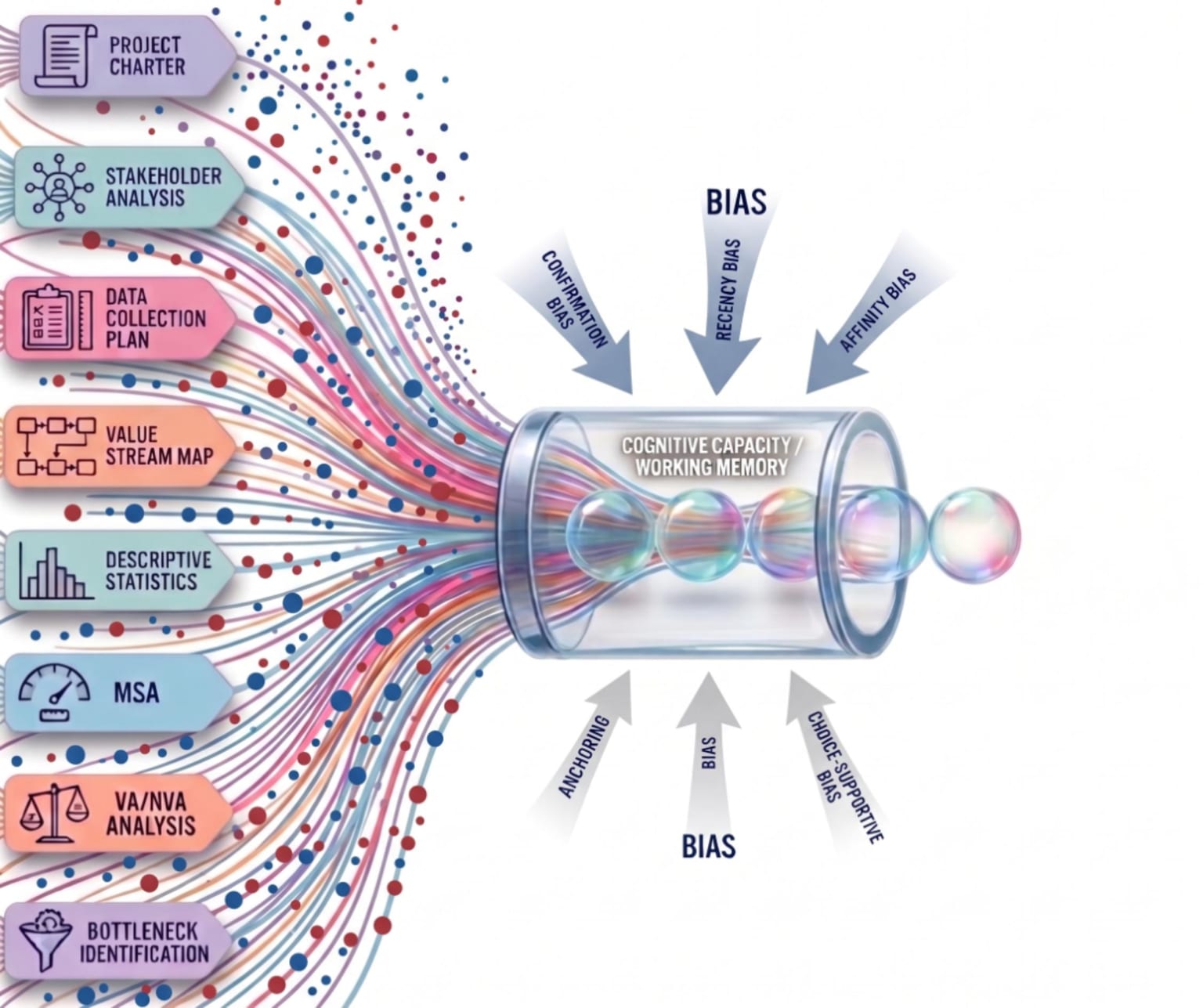
The value of AI in DMAIC isn't "giving answers." It's reducing the cognitive load that leads to misdiagnosis. But as I covered in Why DMAIC Needs a Harness, Not a Chatbot, a simple conversational interface can actually increase cognitive load by adding more unstructured noise to the process.
To truly support a project team, AI needs to function as an engineered harness — a digital backbone that does the heavy lifting of connecting your data points and keeping the project's logic locked in from the Charter all the way to the Control plan.
Instead of just chatting, an AI harness works for the Belt by:
AI protects the team from the cognitive traps that sabotage the Analyze phase.
For all its strengths, AI cannot do human work. AI analyzes; humans understand. AI sees patterns; humans decide what matters.
AI cannot:
If misdiagnosis is the root cause of project failure — and cognitive overload is the root cause of misdiagnosis — then the countermeasure isn't more tools or better prompts. It's engineered cognitive support.
In recent articles, I've explored how structured AI harnesses are changing the landscape for Green and Black Belts. The conclusion is the same every time: Lean Six Sigma doesn't need more information. It needs better cognitive infrastructure.
That's why I built Sensei Elite — not to replace the project team, but to protect them from the overload and bias that quietly undermine DMAIC at scale.
Ready to give your team an engineered cognitive harness instead of another chatbot? Start your free 30-day trial of Sensei Elite — no credit card required — or view pricing plans.
Found this helpful?
What is cognitive load in the context of Lean Six Sigma?
Cognitive load is the amount of information your working memory has to hold and process at one time. Cognitive research shows working memory can only hold 3 to 5 'chunks' of information at once. The Analyze phase of DMAIC routinely demands synthesis of hundreds of data points — VOC themes, MSA results, capability data, process maps — which overloads the brain and triggers shortcuts like anchoring and confirmation bias.
Why do so many Lean Six Sigma projects still fail to deliver lasting results?
By many estimates, half or more of LSS projects fail to deliver or sustain their intended results. Leadership buy-in, data quality, and belt discipline are real factors — but an overlooked one is cognitive overload during the Analyze phase. When teams hold too many variables in their head, bias takes over and misdiagnosis follows. The countermeasure isn't more tools; it's engineered cognitive support.
How does an AI harness reduce cognitive load during DMAIC analysis?
An engineered AI harness — unlike a generic chatbot — does the heavy lifting of connecting data points and preserving project logic from Charter to Control plan. It sifts thousands of data points for weak signals, validates outliers, prevents project drift by cross-referencing findings against the problem statement, and runs the full variable checklist with consistent scrutiny — protecting the team from anchoring, confirmation bias, and premature convergence.
AI and Lean Six SigmaJuly 25, 2026 · 6 min read
 AI and Lean Six Sigma
July 13, 2026 · 4 min read
 AI and Lean Six Sigma
July 7, 2026 · 4 min read