 AI and Lean Six Sigma
Part 2 - What You'd Actually Measure in a Lean Six Sigma Coach
July 13, 2026 · 4 min read


Mike Higgins · July 25, 2026 · 6 min read

Walk any well-run production line and you'll notice something quietly remarkable: one experienced team leader can support far more work stations than they could ever watch individually — because the line is built to call them when it needs them.
That's jidoka, what Taiichi Ohno called "automation with a human touch": processes built to run on their own and stop themselves the instant something abnormal appears (Ohno, 1988). An operator at a stopped station pulls the andon cord — a signal that summons a human to the exact spot that needs judgment and problem-solving. The team leader doesn't hover over every station hoping to catch a defect; they wait for the signal, and when it's pulled they're there.
The andon signal didn't replace the human expert. It dignified them — it said their attention was too valuable to spend watching a machine that was running fine.
Now hold that against how we coach Lean Six Sigma.
To be fair, coaches aren't flying blind. Anyone carrying dozens of practitioners and projects keeps some system — a status spreadsheet, a project tracker, a steady stream of "where are you at?" and "send me your files" emails, weekly check-ins, and tollgates. At times in my career I was supporting 15–20 practitioners and 45+ projects across a large geographic area — administratively overwhelming, forever chasing the current status of projects. By the time I became aware a project was drifting, days or weeks could have passed between emails, coaching sessions, tollgates, or check-ins — but it was a system. And the research is blunt about that load: as a coach's caseload climbs, the quality of their coaching falls — hardest on the newest belts, the ones with the least judgment to fall back on (Rothwell et al., 2021).
And notice that none of it is actually coaching. Run the value analysis on a coach's time and the result won't surprise any experienced practitioner: the overwhelming majority of a coach's hours go to non-value-added work — status-chasing, update-hunting, report prep. The value-added core — building rapport, sitting with a struggling practitioner, asking the one question that unsticks a project — is the thin slice getting squeezed out with additional load. So the move isn't to strip tasks from the coach; it's to remove the burden that was never coaching in the first place. On the line, andon doesn't exist to catch a worker slacking — it protects their attention and points it at what matters. The lagging spreadsheets, trackers, and emails become redundant, replaced by coaching by exception — a jidoka principle.
It's the same idea Ohno had: let the routine run itself, and engineer the system to summon the human the moment judgment is actually required. For coaching, that's two parts.
One — something holds the method when the coach isn't there. Between sessions, a practitioner still hits walls at 11 a.m. on a Friday when the coach is unavailable (Higgins, 2026c) — and most of those moments don't need a coach. They need a disciplined question, grounded in the context of their project, at the right time to get unstuck — the kind that walks a practitioner through a data collection plan: "What factors do you want to stratify this data by, so you can slice it for analysis later?" or "Is the data discrete or continuous?" That kind of on-demand, method-holding guidance is precisely how intelligent tutoring systems have recovered much of the one-to-one advantage in education (VanLehn, 2011).
Two — and this is the whole point — the system needs an andon signal. When a project deviates in a way that needs human judgment or expertise — a stopped station — it surfaces on its own, in real time, the moment it happens instead of at the next review. When the cord is pulled, you're there, fully, on the project that needs your judgment, rather than spread in a thin film across forty-plus projects.
The key to scaling scarce coaching expertise — the ratio problem I've written about before (Higgins, 2026a) — is exactly this: coach by exception, where it counts, at full intensity, because a system is watching.
So what does coaching by exception actually run on? A continuous feedback loop between an engine and a dashboard.
The engine is Sensei Elite — a Socratic, gated AI coach that spans more than 40 DMAIC and Kaizen tools. Because it requires active input from the practitioner, it captures methodology rigor and project-health detail as the work happens, generating real-time, honest signals rather than a status report reconstructed weeks later.
The dashboard is the Sensei Elite Coaching Console. It's designed to read those signals from the practitioner app and translate them into a live, prioritized view — surfacing specific methodology events (a project going silent, a missed coaching cadence, an overdue action) and ranking them, so a human coach can see at a glance who needs outreach and judgment now.
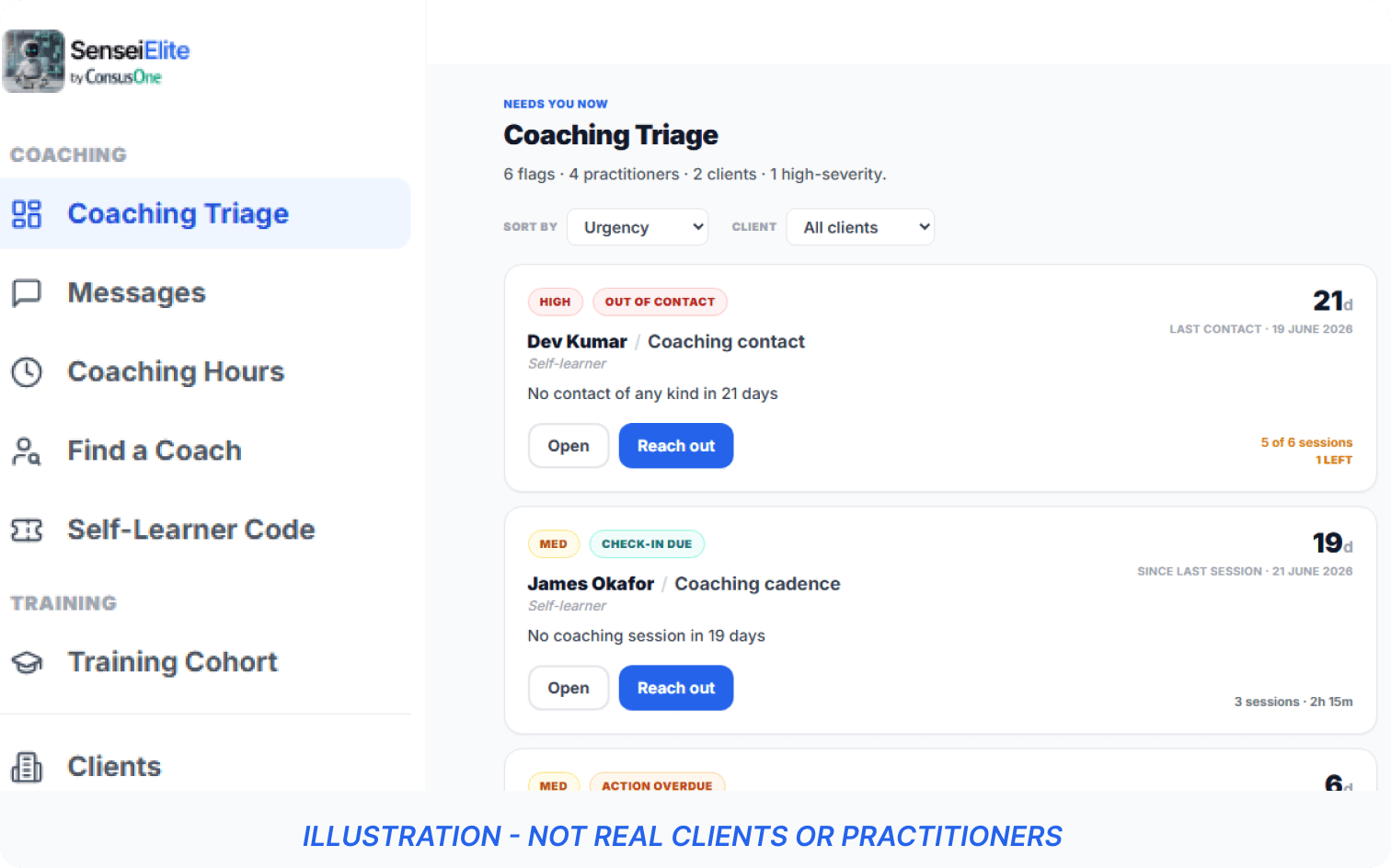
A preview of the Coaching Console (in development): a "Coaching Triage" that ranks who needs a coach's attention now — by flag severity, days since last contact, and overdue commitments. Illustration; not real clients or practitioners.
Together, they're intended to form a single measurement system operating on two levels: Sensei Elite manages project health on the ground for practitioners, while the Console aggregates that signal into coverage, risk, and the coaching effectiveness we otherwise never measure (Higgins, 2026b) — for the deployment leaders and coaches who carry the portfolio.
A phrase comes to mind: eat our own dog food. Lean Six Sigma taught the world to hunt waste, stop the line at the source, and respect people's time — and then we built a coaching model that honors none of them, and never once turned our own tools on it. Coaching by exception is what it looks like to finally take our own advice.
Where does your attention actually go in a given week — to the projects that need you, or to the ones that happen to be loudest? I'd genuinely like to hear how other coaches are handling it.
Want to see coaching by exception in action? Explore Sensei Elite, the live practitioner coaching app, and reach out for a demo of how it feeds the Coaching Console. We're opening a limited number of free pilots of Sensei Elite — and pilot teams get an early look at the Coaching Console as it rolls out. Let's talk about whether your team or practice is a fit.
Higgins, M. (2026a, July 1). Lean Six Sigma's failure rate isn't a methodology problem. It's a math problem. Sensei Elite. https://lsssensei.com/blog/lean-six-sigma-failure-rate-is-a-math-problem
Higgins, M. (2026b, July 7). We measure everything in Lean Six Sigma, except the coach (Part 1). Sensei Elite. https://lsssensei.com/blog/we-measure-everything-except-the-coach
Higgins, M. (2026c, June 23). When the coach isn't there: The three things practitioners do when they're stuck. Sensei Elite. https://lsssensei.com/blog/when-the-coach-isnt-there
Ohno, T. (1988). Toyota production system: Beyond large-scale production. Productivity Press.
Rothwell, C., Kehoe, A., Farook, S. F., & Illing, J. (2021). Enablers and barriers to effective clinical supervision in the workplace: A rapid evidence review. BMJ Open, 11(9), Article e052929. https://doi.org/10.1136/bmjopen-2021-052929
VanLehn, K. (2011). The relative effectiveness of human tutoring, intelligent tutoring systems, and other tutoring systems. Educational Psychologist, 46(4), 197–221. https://doi.org/10.1080/00461520.2011.611369
Found this helpful?
What is "coaching by exception" in Lean Six Sigma?
It's an operating model borrowed from Lean's andon/jidoka principle. Instead of a coach spreading thin attention evenly across every practitioner, a system holds the routine coaching between sessions and surfaces only the projects that have deviated in a way that needs human judgment — so the coach's scarce, high-value attention is routed to where it actually matters, at full intensity.
Isn't "coaching by exception" just automating coaching?
No — it automates the detection of who needs coaching, not the coaching itself. The status-chasing, check-ins, and tollgates that consume a coach's time were never coaching; they're the detection layer that tells you where to point your attention. Coaching by exception automates that layer so the human coach spends their hours on the actual coaching.
Does coaching by exception replace the human coach?
No — it's the opposite. Like an andon cord on a production line, it doesn't replace the expert; it protects and aims their attention. Routine, method-holding guidance runs on its own between sessions, and the human coach is summoned to the exact projects that need judgment.
How does coaching by exception help scale a Lean Six Sigma coaching practice?
A coaching practice is capped by the coach's hours. Coaching by exception changes what a single hour of the coach's attention can cover: an AI coach holds the method with every practitioner between sessions, and a triage layer routes only the exceptions to the human. That lets a coach support more practitioners without diluting the judgment that makes their coaching valuable.
AI and Lean Six SigmaJuly 13, 2026 · 4 min read
 AI and Lean Six Sigma
July 7, 2026 · 4 min read
 AI and Lean Six Sigma
July 1, 2026 · 7 min read