 AI and Lean Six Sigma
Coaching by Exception: The Andon Cord for Your Coaching Practice
July 25, 2026 · 6 min read


Mike Higgins · April 13, 2026 · 12 min read
The buzz around AI in Lean Six Sigma is undeniable. Many practitioners, myself included, have enthusiastically experimented with Large Language Models (LLMs) like ChatGPT or Claude, getting impressive results for specific, isolated LSS tools. Need a quick explanation of p-values? AI delivers. Brainstorming potential X's for a fishbone diagram? AI is fantastic. We've become adept prompt engineers, crafting requests that yield excellent, immediate answers.
But here's the critical question: When your DMAIC project spans weeks or months, requiring a structured, sequential application of over 40 tools, are you getting continuous, cohesive coaching, or just a series of disconnected, one-off conversations? As a Master Black Belt with 25 years of LSS deployment experience across manufacturing, healthcare, and service industries, I've seen this exact challenge play out repeatedly. While generic AI is powerful, it fundamentally struggles with the sustained, integrated coaching required for complex operational excellence initiatives. The problem isn't your prompting; it's rooted in deeper engineering gaps.
One of the most significant limitations of generic LLMs for project-level LSS coaching is their lack of persistent memory regarding your specific project. Each new prompt is largely treated as a fresh interaction, detached from previous context. You might spend an hour refining your Process Map in the Define phase, asking your AI for input.
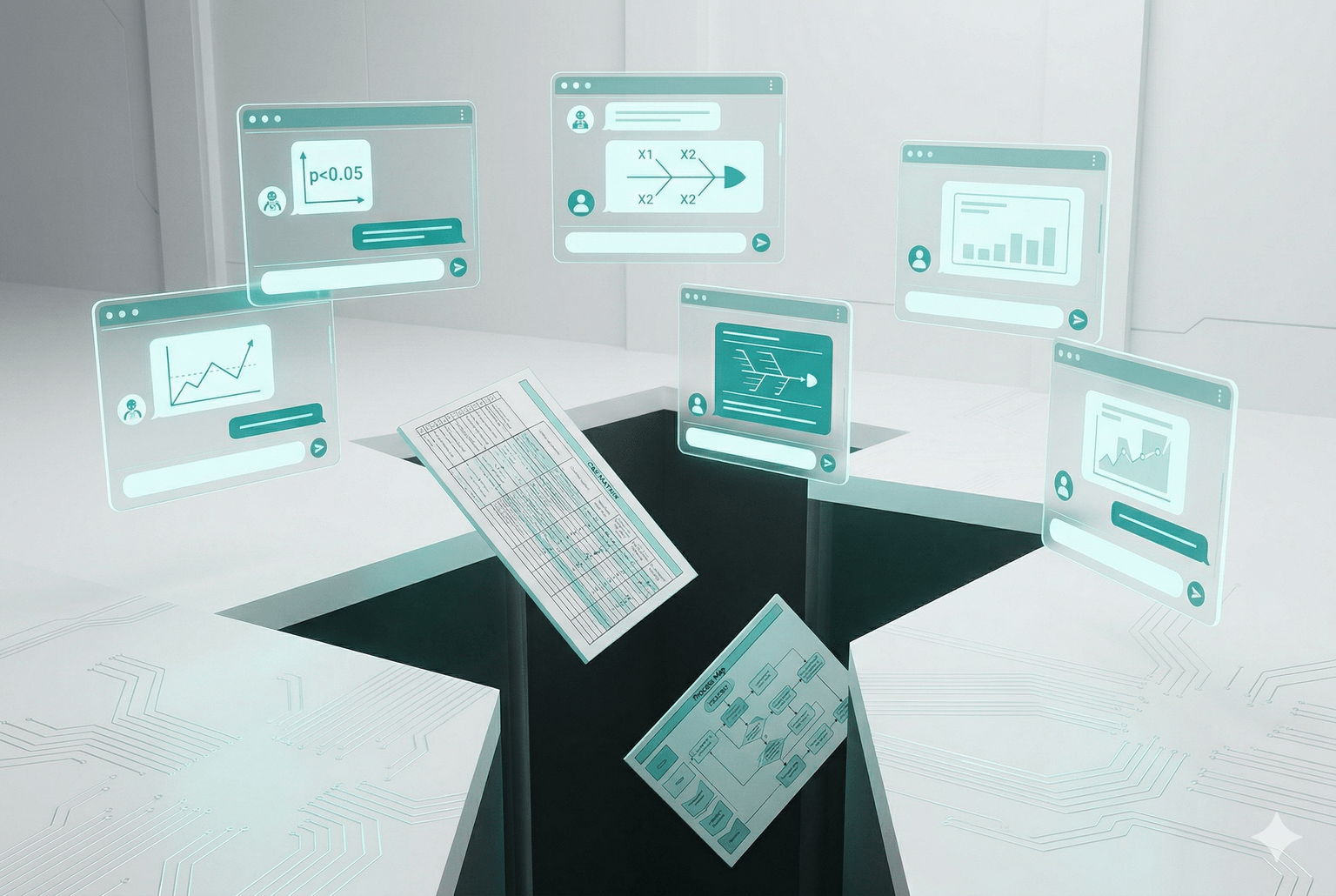
Then, a week later, you move to the Measure phase and ask the same AI about designing a Measurement System Analysis (MSA). The AI, impressive as it is, has largely forgotten the specifics of your process map, its identified waste, or the critical to quality (CTQ) metrics you established earlier. You end up having to re-explain your project context, wasting valuable time and breaking the flow of continuous improvement.
I saw this firsthand at a manufacturing client where we were driving a +5% throughput increase. This wasn't a single tool application; it was a multi-month improvement journey where every step — from defining process boundaries to validating measurement systems and implementing controls — built directly on the previous one. If a coach had to be re-briefed at every single meeting, the project would have collapsed under the weight of lost momentum and re-work.
Lean Six Sigma isn't a collection of disparate tools; it's a disciplined methodology with a logical sequence. A typical Black Belt project can involve 40 or more tools, each feeding into the next. Generic LLMs simply aren't engineered to understand or enforce this complex interdependency.
They can explain what an FMEA is, or even suggest risks. But they won't inherently know that the failure modes you're identifying should directly align with the process steps from your SIPOC, or that the critical inputs from your C&E Matrix are what you should be focusing your MSA on. Furthermore, LLMs are fundamentally stateless — they treat each interaction in isolation, unable to enforce sequential progression or flag when a critical prerequisite has been skipped.

Ask a generic AI to help you build a Cause & Effect Matrix. It will ask thoughtful questions, suggest potential X's and Y's, and produce something that looks comprehensive. But when is it done? The AI has no built-in criteria for tool completion. It will keep asking questions indefinitely — or worse, tell you it looks great when critical inputs are missing.
An experienced MBB knows that a C&E Matrix is complete when the process steps from your SIPOC are represented, when the team has scored the relationships, and when the vital few X's have been identified for further investigation. That's not prompt knowledge — that's methodology knowledge embedded in a coaching system.
Without completion awareness, practitioners face two failure modes: they stop too early (incomplete analysis) or they never stop (analysis paralysis with the AI asking endless refinement questions). Both waste time and erode confidence in the methodology.
Without application-level guardrails, LLMs default to lengthy, highly technical responses. They're optimized to demonstrate knowledge, not to coach. A Green Belt asking about their first control chart doesn't need a statistics lecture — they need "here's your next step, here's why, here's what to watch for."
Getting an AI to consistently deliver concise, actionable, level-appropriate guidance isn't a prompting problem. You can write "keep answers short" in your prompt, and it works for two or three exchanges before the AI drifts back to verbose mode. Sustained response calibration requires engineering at the application layer.
These aren't criticisms of AI — they're observations about where the technology ceiling currently sits for sustained project coaching. The limitations break down into four engineering challenges:
None of these can be solved with a better prompt. They require purpose-built engineering — the kind of infrastructure that sits beneath the conversational layer.

This is exactly why I built Sensei Elite. After 25 years of coaching practitioners through DMAIC, Kaizen, and PDCA projects — from Fortune 500 manufacturer production floors to international organization improvement programs — I kept seeing the same pattern: talented practitioners with good tools who got stuck between coaching sessions because nobody was there to maintain the thread.
View Sensei Elite's pricing plans at lsssensei.com/pricing or contact us directly at lsssensei.com/contact.
If you're using ChatGPT or Claude for Lean Six Sigma, you're not doing anything wrong. For individual tools and quick answers, generic AI is genuinely useful. But if you're running a full DMAIC project and expecting sustained coaching from a series of disconnected prompts, you'll hit a ceiling — and it won't be a prompt quality ceiling.
The gap between a great prompt and effective project coaching is an engineering gap. Memory, completion logic, cross-phase validation, and response calibration aren't features you can prompt into existence. They're infrastructure that has to be built.
That's the difference between an AI that answers questions and an AI that coaches you through a project. Discover how Sensei Elite bridges that gap at lsssensei.com.
Found this helpful?
Can I use ChatGPT or Claude as a Lean Six Sigma coach?
Generic AI works well for individual LSS tools and quick answers. However, for sustained project coaching across weeks or months, it lacks persistent memory, tool completion awareness, cross-phase validation, and response calibration — engineering gaps that better prompts cannot solve.
Why can't a better prompt fix AI coaching limitations for DMAIC projects?
The limitations of generic AI for DMAIC coaching — session memory loss, no completion criteria for 40+ tools, inability to validate cross-phase consistency, and response verbosity — are engineering problems requiring application-level infrastructure, not prompt-level solutions.
What engineering is needed for effective AI-powered Lean Six Sigma coaching?
Effective AI coaching for LSS requires four engineering capabilities: persistent project memory across sessions, built-in completion logic for each methodology tool, cross-phase validation ensuring artifacts connect correctly, and response architecture calibrated to practitioner experience level.
AI and Lean Six SigmaJuly 25, 2026 · 6 min read
 AI and Lean Six Sigma
July 13, 2026 · 4 min read
 AI and Lean Six Sigma
July 7, 2026 · 4 min read