 AI and Lean Six Sigma
Coaching by Exception: The Andon Cord for Your Coaching Practice
July 25, 2026 · 6 min read


Mike Higgins · April 17, 2026 · 9 min read
The conversation around Artificial Intelligence often stirs a mix of excitement and apprehension. In the world of Lean Six Sigma (LSS), where precision, efficiency, and human ingenuity have long been paramount, the question isn't whether AI will disrupt our field, but how we can harness it to amplify our impact.
I've seen firsthand how teams get bogged down by repetitive tasks. AI isn't here to replace human expertise; it's here to strategically reallocate our most valuable asset: human talent. By automating the mundane, AI frees up LSS practitioners for the complex, strategic thinking and problem-solving where human judgment is irreplaceable.
Lean Six Sigma has always been about optimizing processes and eliminating waste but, we have not fully explored this within our process — DMAIC. Historically, this has involved significant manual effort — from data collection and analysis to process mapping and report generation. While these are critical steps, they often consume valuable time that could be spent on deeper analysis, stakeholder engagement, and innovative solution design. The manual nature of the steps could also drive the practitioner to miss a significant contributing variable.
AI transforms this landscape by taking on many of these repetitive, non-judgmental tasks:
Tasks such as counting boxes on a pallet or sorting parcels by reading labels are mundane repetitive tasks with a low accuracy expectation. Implementing AI-driven vision systems can significantly increase the accuracy of these tasks, preventing downstream rework and issues with customers. By automating these checks, we can reallocate resources to more value-added activities.

To transition from a traditional practitioner to a Lean Six Sigma AI Generalist, we need the body of knowledge to include "Agentic AI" and no-code automation within the DMAIC framework.
We no longer wait weeks for manual surveys. AI Generalists use Claude 3.5 Sonnet or GPT-4o to perform instant sentiment analysis on thousands of customer emails or logs to define the "Voice of the Customer" (VOC). We then leverage n8n to build automated data pipelines that ingest and clean data from SQL databases or ERP systems in real-time, eliminating the manual "data crunching" that bogs down projects.
AI excels at identifying intricate patterns at speeds unmatched by humans. Instead of just looking at what happened (descriptive stats), Black Belts now use Akkio or DataRobot for predictive modeling. This allows for faster Root Cause Analysis by correlating hundreds of variables simultaneously to find the "Vital Few" far quicker than manual methods.
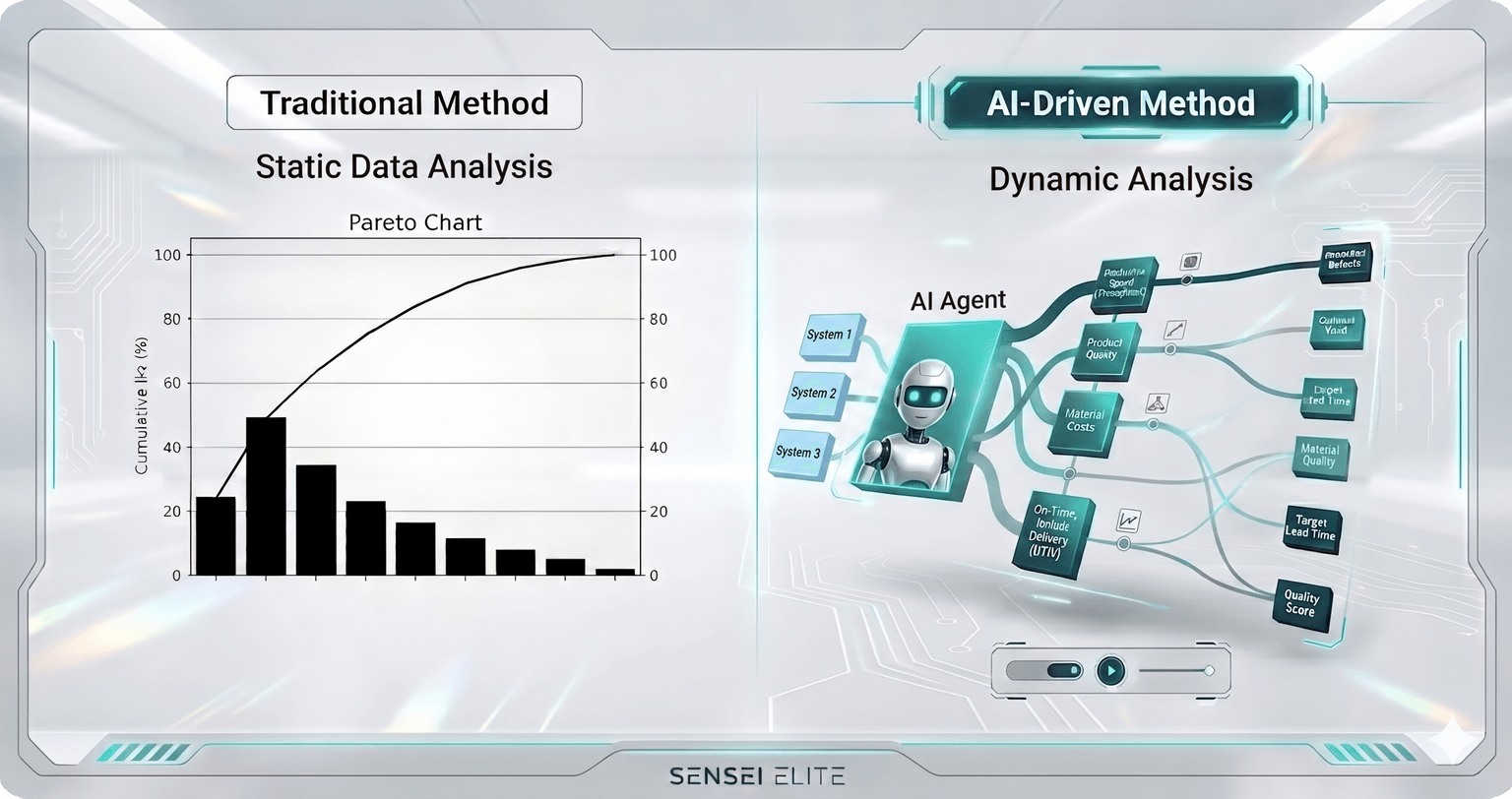
In the Improve phase, we don't just "lean out" a process; we "agentize" it. By leveraging n8n in conjunction with Claude or Gemini 1.5 Pro, we deploy AI agents that act as a front-line triage system.
Instead of practitioners being bogged down by the friction of manual categorization or repetitive data entry, these agents handle the "mundane" heavy lifting — such as performing initial sentiment analysis, classifying intent, or even drafting preliminary C&E matrix inputs and FMEA failure modes based on historical project data.
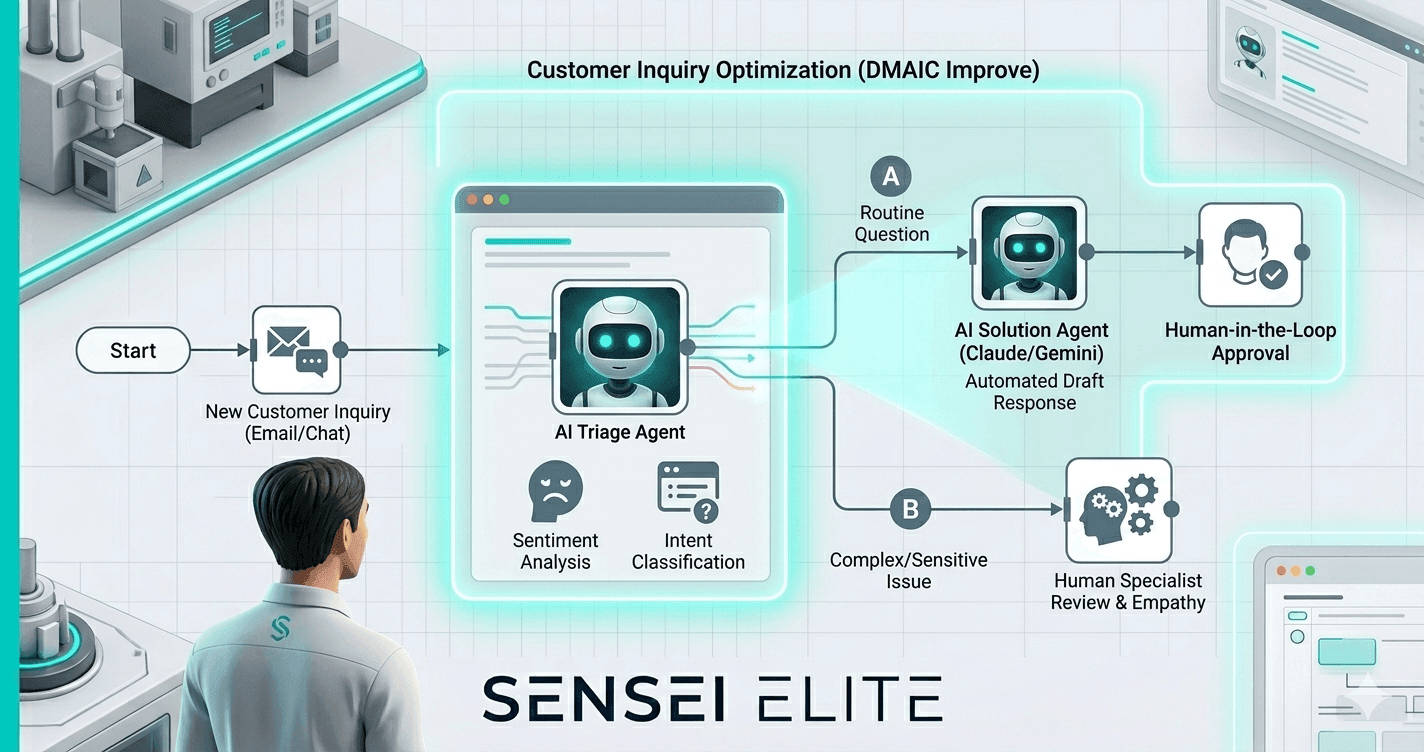
As seen in the workflow above, this Agentic LSS approach creates a dual-path system: routine tasks are automated for speed, while complex, sensitive issues are routed directly to the human practitioner. This allows Lean Six Sigma leaders to bypass the non-value-added "paperwork" and jump straight into validating results and human-centric strategizing.
Traditional 5S sustainment often fails due to manual, high-friction 5S audits that leaders abandon during production "fires." Replace this decay with a Frictionless Accountability Loop. Practitioners compress a 15-minute chore into a 60-second AI photo taken by their phone, then AI computer vision instantly compares current state to digital baselines for objective scoring.
The application in turn automatically notifies zone owners via email or WhatsApp while keeping track of corrective actions. By replacing a manual, time-consuming, and inefficient pen-and-paper auditing process with AI and automation, you have made the right thing to do, the easy thing to do.

The future trajectory of Lean Six Sigma is predicated upon a robust synergy: structured problem-solving and process enhancement augmented by artificial intelligence and automation. To fully realize the potential of this evolution and cultivate the Lean Six Sigma AI Generalist, a requisite revision of the curriculum is necessary. Future LSS Green and Black Belts must undergo practical training utilizing instruments such as Claude, Gemini, or n8n, applying them comprehensively across the entire DMAIC framework. By adopting this institutional modification, LSS leadership can foster organizational cultures where their personnel are empowered to engage in more critical thinking and pursue more audacious innovation.
Ready to see how Sensei Elite can empower your LSS journey? Explore Sensei Elite | View Pricing
Found this helpful?
How is AI changing the DMAIC methodology?
AI reshapes each DMAIC phase: automated VOC and data pipelines in Define & Measure, predictive root cause analysis in Analyze, agentic triage workflows in Improve, and computer-vision 5S audits in Control. The result is less manual effort and more time for practitioners to focus on strategic problem-solving.
Will AI replace Lean Six Sigma Black Belts?
No. AI reallocates practitioner effort rather than replacing it. Human judgment remains irreplaceable for defining the right problem, designing context-specific solutions, ensuring ethical implementation, and validating AI output — which can be subtly wrong. AI is an accelerator, not a substitute.
What AI tools should a Lean Six Sigma practitioner learn?
Modern LSS practitioners benefit from learning agentic AI platforms (Claude, GPT-4o, Gemini), no-code automation tools like n8n for building data pipelines, predictive modeling platforms like Akkio or DataRobot, and computer-vision-based audit tools to power the Control phase's Frictionless Accountability Loop.
AI and Lean Six SigmaJuly 25, 2026 · 6 min read
 AI and Lean Six Sigma
July 13, 2026 · 4 min read
 AI and Lean Six Sigma
July 7, 2026 · 4 min read