 Problem Solving
When the Coach Isn't There: The Three Things Practitioners Do When They're Stuck
June 23, 2026 · 5 min read


Mike Higgins · June 23, 2026 · 5 min read

Every practitioner knows the feeling. You had momentum on your project, and then you hit a wall. Your next coaching session is two weeks out. You open your process map, stare at it, close it again. The worst part isn't the wall itself — it's that you can't even name what's wrong.
This is the Certification-to-Execution gap I wrote about in April, seen up close. You know the framework — but the framework doesn't tell you what to do when you're standing in front of a specific wall on a specific project — this is when coaching earns its value.
Here's the reframe that gets you moving: "I'm stuck" tells you nothing useful. Being stuck in Define is a completely different problem from being stuck in Analyze, and they need opposite responses. The fastest way out is not to push harder on the whole project — it's to locate the blockage precisely, then ask the one question that clears it.
Below is the phase-by-phase diagnostic I use. Find the phase you're actually in, and the question under it is the one to sit with.
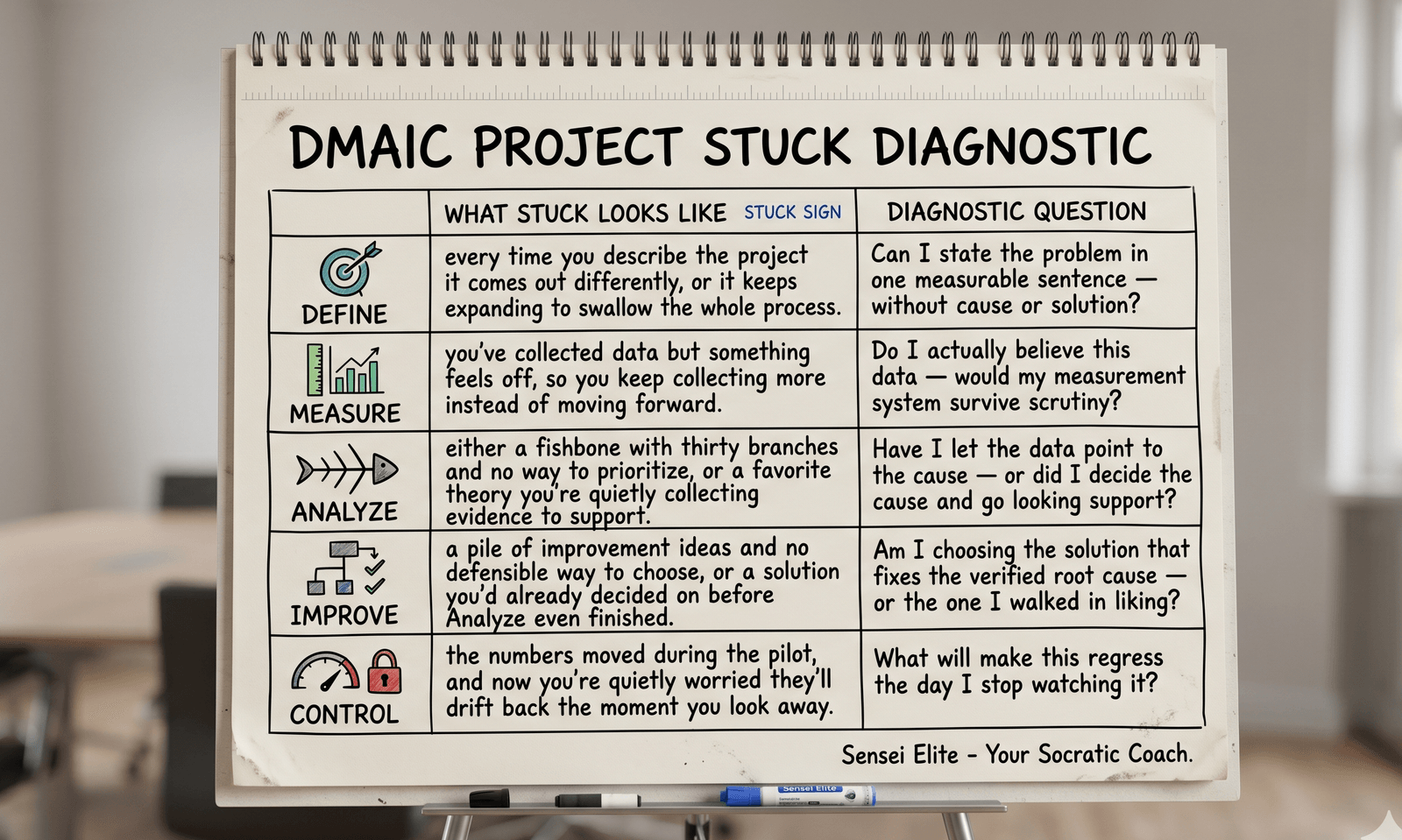
What "stuck" looks like: every time you describe the project it comes out differently, or it keeps expanding to swallow the whole process.
The diagnostic question: Can I state the problem in one measurable sentence — without naming a cause or a solution? If you can't, you're not stuck on the project; you're stuck on scope.
What "stuck" looks like: you've collected data but something feels off, so you keep collecting more instead of moving forward.
The diagnostic question: Do I actually believe this data — would my measurement system survive scrutiny? Stalling in Measure is almost always an unspoken doubt about the measurement system or the baseline. Name the doubt and you can act on it.
What "stuck" looks like: either a fishbone with thirty branches and no way to prioritize, or a favorite theory you're quietly collecting evidence to support.
The diagnostic question: Have I let the data point to the cause — or did I decide the cause and go looking for support?
This is the most common place to stall — often it's simply when too many candidates are held in the team's head at once, so you grab the nearest familiar one. It's also the most dangerous place to stall, because a wrong "verified" cause feels exactly like a right one. See my article on How AI Reduces Cognitive Overload in Lean Six Sigma.
What "stuck" looks like: a pile of improvement ideas and no defensible way to choose, or a solution you'd already decided on before Analyze even finished.
The diagnostic question: Am I choosing the solution that fixes the verified root cause — or the one I walked in liking?
What "stuck" looks like: the numbers moved during the pilot, and now you're quietly worried they'll drift back the moment you look away.
The diagnostic question: What will make this regress the day I stop watching it? If you can answer that, you know exactly what your control plan has to defend against.
Notice what every one of those questions has in common: none of them gives you the answer. They locate where the thinking broke down so you can do the work. That self-diagnosis — knowing which wall you've hit and which question to ask — is the capability that separates a belt who finishes projects from one who stalls.
It's also the single hardest skill to build alone, because being stuck narrows your thinking at exactly the moment you need it widest. That's why a good coach feels like magic: they don't hand you the answer, they ask the question that makes the block obvious.
The catch happens at 11 a.m. on a Friday, mid-Measure phase, when there is intense pressure to keep the project moving — but your coach is not available. Many practitioners fall back on one of three actions: wait, reach for generic AI, or guess. Each feels productive, but each quietly costs the project momentum. I will be writing about this trap in my next blog post.
The better move is the one this whole piece is about: don't push harder on the project — locate the block, name the phase, and ask the one question that clears it. That's not a trick; it's the core skill a good coach builds in you, and the one Sensei Elite is designed to keep sharp between your sessions — by asking, not answering.
Found this helpful?
What does it mean to be "stuck" on a DMAIC project?
Being "stuck" is a symptom, not a diagnosis. It usually means you've hit a specific obstacle in a specific DMAIC phase — an unclear scope in Define, distrust of your data in Measure, too many causes in Analyze — and haven't yet named which one. Locating the phase is the first step to getting moving.
How do I know which DMAIC phase I'm stuck in?
Work backward from the symptom. If you can't state the problem in one measurable sentence, you're stuck in Define. If you don't trust your data, it's Measure. If you can't prioritize causes, it's Analyze. Each phase has a tell-tale form of "stuck."
How can I get unstuck between coaching sessions?
Use a diagnostic question for the phase you're in rather than pushing harder on the whole project. Tools like Sensei Elite provide on-demand Socratic coaching between human sessions to help you locate the blockage and take the next step.
Problem SolvingJune 23, 2026 · 5 min read