 AI & Technology
Why Your AI 'Cheerleader' is Sabotaging Your Continuous Improvement Project
May 8, 2026 · 3 min read


Mike Higgins · June 24, 2026 · 5 min read

Strip away the belts, the tollgates, and the acronyms, and Lean Six Sigma exists for one reason: to deliver measurable, sustained results for the organization through continuous improvement. Nobody in this field disputes that.
But here's the part that's easy to forget while you're staring at a charter template: those results don't come from the tools. They come from people who can critically think — leaders and team members who can frame a problem, interrogate data, and land on a root cause that holds up under pressure. That's why building problem-solving capability is a pillar of every serious continuous improvement deployment. The tools are just where that thinking gets recorded.
You can't download problem-solving capability. It's built the slow way: formal training, execution on real projects, and working alongside an expert coach who challenges your thinking, guides you when you drift, and teaches the why behind the method.
That's the whole reason organizations invest in coaching in the first place — a good coach doesn't hand you the answer, they ask the question that makes you find it. It's also why the distance between earning a belt and actually delivering a project is so real: the certification-to-execution gap is a capability gap, not a knowledge gap (Higgins, 2026a).
Now drop AI into that picture. On a Lean Six Sigma project, AI can play one of two very different roles:
Both produce a finished artifact. Only one produces a better problem-solver. And that difference is the entire ballgame.
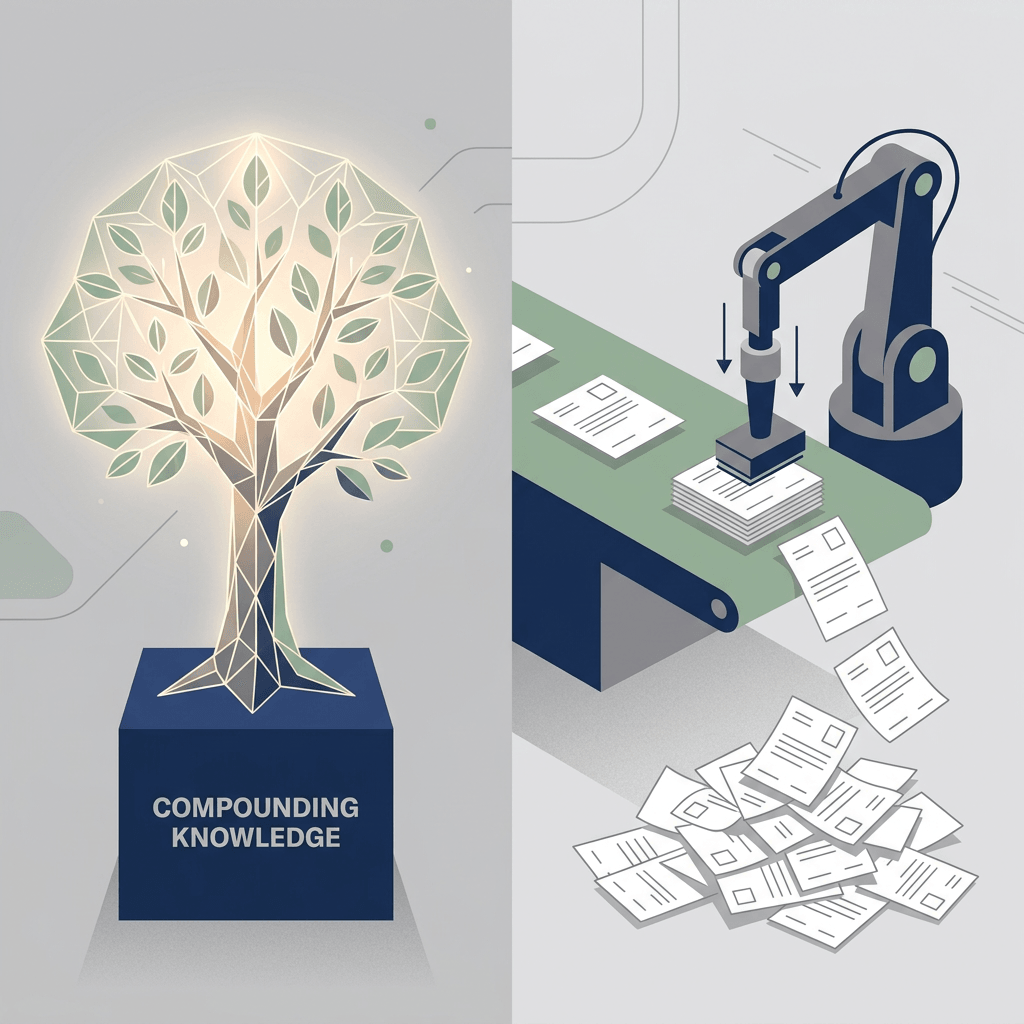
Think about it the way a CFO thinks about any investment.
When AI partners with expert coaches to develop critical thinking, the return compounds. The practitioner who was challenged to reason through the root cause is sharper on the next one — and the one after that. The capability spreads, the thinking gets better, and the organization extracts more results from every future project. That's a compounding return on a single investment.
When AI is used to fill in the blanks, the return depreciates. You get one artifact, once. No capability was built, so the next project starts from zero — the organization re-spends to get the same output again. Worse, the practitioner who let the AI think for them walks away less able to think for themselves, not more. The skill quietly erodes (Higgins, 2026b), and you paid for the privilege.
Finishing a tool faster feels like a win — even if it looks and feels correct. But without the thinking behind the output, the return on investment erodes with time.
Using AI to simply complete deliverables isn't just a missed chance to build a skill. It runs directly counter to the reason Lean Six Sigma exists. If the goal is sustained results through capability, then an AI that manufactures deliverables without building capability is optimizing for the opposite of the goal. It's an AI that agrees instead of challenges and validates instead of teaches — the cheerleader, not the coach (Higgins, 2026d). You end up with a stack of polished artifacts and an organization no more capable than the day you started. Fast, and strategically backwards.
Effective AI in Lean Six Sigma mirrors the traditional role of an expert coach: it guides, instructs, and challenges. Instead of providing the answer, it asks the right question. By partnering with human coaches rather than replacing them, the right AI ensures practitioners adhere to the methodology, fostering the professional judgment that creates compounding value.
This commitment to developing the practitioner rather than simply doing their work is the foundation of Sensei Elite. It offers an AI coaching experience that remains available even when a human coach is absent (Higgins, 2026c), ensuring that capability-building continues during the critical periods between formal sessions where most practical learning occurs.
Ultimately, the choice isn't about adopting AI — it's about whether you use it to build your long-term capability or allow your skills to diminish.
Found this helpful?
What is the ROI of using AI in Lean Six Sigma?
It depends entirely on how you use it. AI used to develop critical thinking and problem-solving capability produces a compounding return — practitioners get better at every future project. AI used to auto-complete deliverables produces a depreciating return — one artifact, no capability built, and skills that erode over time.
Is it bad to use AI to fill in a project charter or other DMAIC tools?
It produces a fast deliverable but builds no capability — and capability is the actual point of Lean Six Sigma. Using AI to complete forms without challenging or teaching works against the strategic goal of sustained results through continuous improvement.
How should AI be used in Lean Six Sigma?
In the role a good coach plays — challenging weak thinking, guiding practitioners to their own answers, and teaching the method — so it builds the problem-solving capability that compounds across an organization's projects.
AI & TechnologyMay 8, 2026 · 3 min read
 AI & Technology
May 4, 2026 · 9 min read