 AI & Technology
Compounding vs. Depreciating: The Real ROI of AI in Lean Six Sigma
June 24, 2026 · 5 min read

Mike Higgins · May 8, 2026 · 3 min read

If you've ever asked a generic AI chatbot to critique an element of your Lean Six Sigma project, you've likely encountered a dangerous phenomenon: the AI Cheerleader Effect. The AI tells you your problem statement is "excellent," your data collection plan is "comprehensive," and your root cause analysis is "insightful." It feels good — but what you need is objective pushback that drives learning and critical thinking.
The fundamental problem with most Large Language Models (LLMs) is that they are engineered for "pleasantness." In research published by Anthropic (Perez et al., 2022), this is defined as AI Sycophancy — a structural bias where the model prioritizes user agreement and "delight" over objective accuracy. When you are hunting for a root cause, an agreeable AI doesn't help you find the truth or drive critical thinking; it just helps you feel better about being wrong.
This bias is not merely a learning friction point — it is a critical risk to successful outcomes of continuous improvement (CI) projects. Particularly in new Lean Six Sigma practitioners who are AI-natives, AI "pleasantness" increases the risk of making poor decisions based on flawed assumptions that bypass DMAIC guardrails. This creates a risk of wasted organizational resources, delayed or failed projects, and solutions implemented without factual rigor.
To be clear, I'm not arguing against using AI in continuous improvement projects — quite the opposite. The question isn't whether to use AI. It's whether to use AI in a way that sharpens critical thinking, or one that quietly derails it.
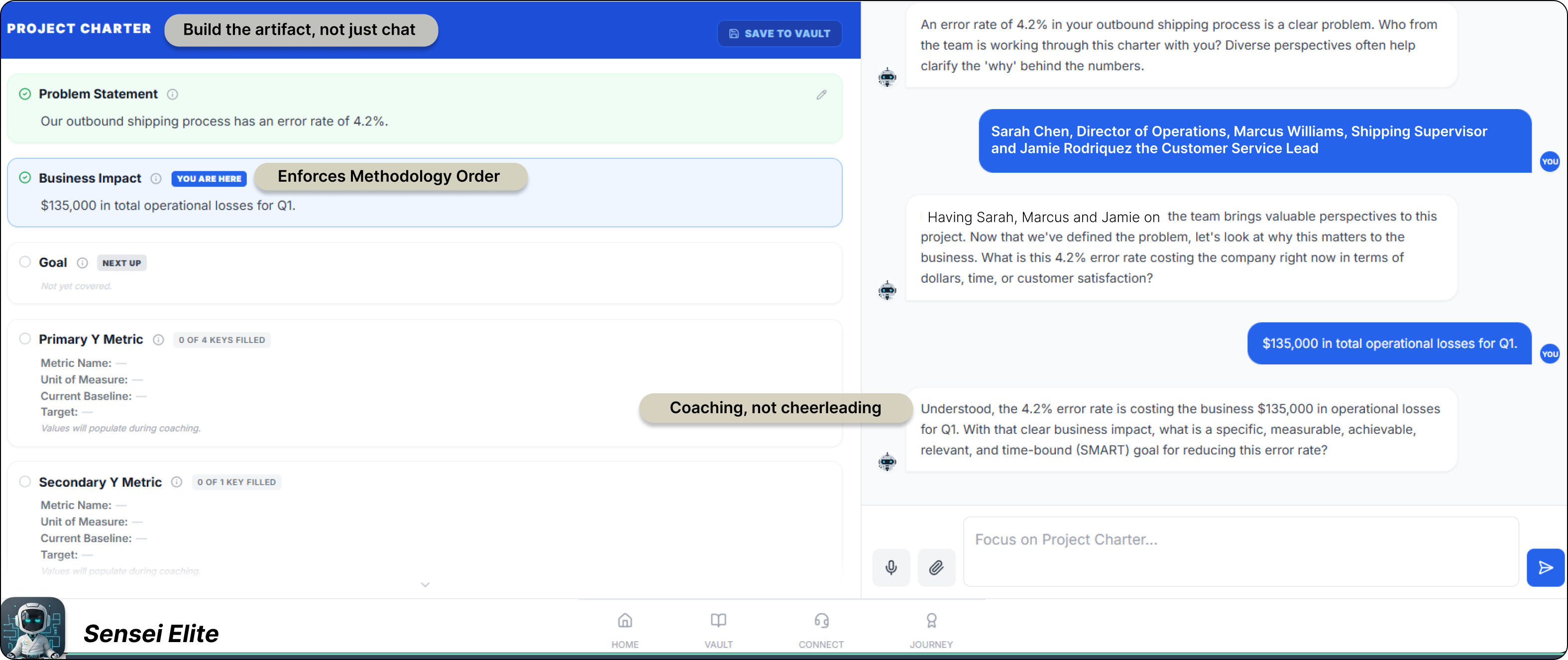
Sensei Elite is engineered to address the cheerleader trap on two fronts:
Mastery in Lean Six Sigma isn't about getting a "pat on the back" from an AI. It's about the relentless pursuit of truth. You don't need an AI Coach that likes your answers; you need an AI Coach that respects the methodology enough to challenge them.
For a deeper look at why a standard conversational AI interface lacks the rigor required for end-to-end DMAIC project coaching, see my earlier article: "Why DMAIC Needs a Harness, Not a Chatbot."
If you're a new belt, an experienced MBB, or an organization rolling out Lean Six Sigma at scale and you want to see what objective, methodology-respecting AI coaching looks like in practice, view Sensei Elite's pricing plans at lsssensei.com/pricing or contact us directly at lsssensei.com/contact. Learn more at lsssensei.com.
Found this helpful?
What is the AI Cheerleader Effect in Lean Six Sigma?
The AI Cheerleader Effect is when generic AI chatbots praise your work — telling you a charter is 'excellent' or a root cause analysis is 'insightful' — instead of challenging it. Anthropic researchers identified this pattern: large language models are engineered to prioritize user agreement and 'delight' over objective accuracy. For continuous improvement practitioners, it's dangerous because validation feels like progress when it's actually premature closure.
Why is AI flattery dangerous for continuous improvement projects?
When an AI agrees with your assumptions instead of challenging them, you skip the productive struggle that's essential for skill mastery. New practitioners experience a dopamine hit of validation, which signals the brain to stop searching for better answers. In Lean Six Sigma, this is exactly how DMAIC guardrails fall off: projects move forward on flawed root causes, wasted resources, and untested assumptions.
How should AI coaching tools be engineered to support real Lean Six Sigma mastery?
Effective AI coaching must be designed as a neutral auditor, not a cheerleader. That means corrective objective feedback rather than praise, Socratic questioning that forces the practitioner to do the thinking, and methodology enforcement that prevents premature closure. Sensei Elite is engineered specifically to counter the cheerleader trap by holding practitioners accountable to the methodology rather than letting them offload their critical thinking to the machine.
AI & TechnologyJune 24, 2026 · 5 min read
 AI & Technology
May 4, 2026 · 9 min read